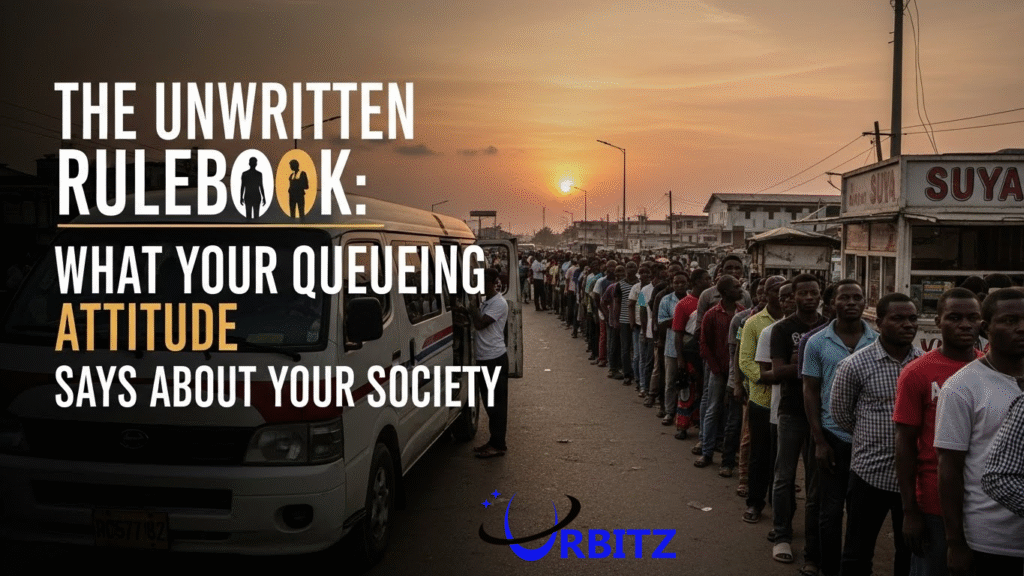
We all queue. At the ATM, for buses, for security checks, for Iya Basira’s world famous ‘Amala with Abula’. But the how of it—the silent dance of positioning, patience, and perception—varies dramatically from place to place. Anthropologists and travel writers have long noted that you can take the temperature of a culture not by its grand monuments, but by its most mundane ritual: the act of standing in line. The queue, it turns out, is a powerful cultural barometer.
The Queue as a Social Mirror
At its core, a queue is a physical manifestation of a society’s values. It answers fundamental questions:
- How do we balance individual desire with collective good?
- What is our relationship with rules, both written and unwritten?
- How do we define and enforce fairness?
- What is our perception of time and patience?
The answers to these questions, played out daily at filling stations and bus stops, reveal a culture’s deepest social DNA.
A World in Line: Cultural Case Studies
The Rule of Order: The UK, Japan, and Germany
In these cultures, the queue is sacrosanct. In Britain, queueing is a national pastime wrapped in a virtue, a test of “stiff upper lip” and fair play. The line is self-policing; a tut or a stern look is often enough to correct a transgressor. In Japan, the queue (retsu) is an exercise in harmony and collective efficiency. Lines are impeccably straight, silent, and respectful of space, reflecting a profound societal commitment to wa (harmony) and avoiding meiwaku (causing trouble). Germany follows a similar pattern, valuing Ordnung (order) and predictability. The queue is logical, efficient, and universally respected. Here, the culture measures high on collectivism in this context, but with a strong emphasis on procedural fairness for the individual within the system.
The Fluid Negotiation: Italy, India, and Parts of China
In many Southern European, South Asian, and Middle Eastern societies, what appears to be a “non-line” to an outsider is actually a different system: a dynamic, fluid social negotiation. Personal relationships, urgency, and vocal assertion can play a larger role than strict chronological order. This isn’t necessarily seen as “rude” within that context; it’s a different mode of operation where the line is more porous and responsive to immediate human need and social capital. It reflects cultures that are often more communally oriented in family life, but more competitively individual in public transactions, with a lower trust in impersonal systems.
The Individual Frontier: The United States
The U.S. presents a fascinating hybrid. There is a strong cultural belief in “first come, first served” fairness. However, this coexists with a celebrated spirit of individualism and ingenuity aimed at beating the system. The American obsession with “express lanes,” premium queueing (Disney’s FastPass, TSA PreCheck), and a certain tolerance for “line-skipping” if done with sufficient chutzpah speaks to a tension between egalitarian ideals and a deep-seated drive for individual exceptionalism. The queue is fair, but finding a faster way through it is the American Dream in miniature.
The New Frontier: The Digital Queue
Our cultural attitudes are now transplanting seamlessly into the digital realm. The “virtual waiting room” for concert tickets tests a society’s patience and tech-savviness. Does everyone refresh at the same time, or do they use bots? The collective sigh on social media when a website crashes is the digital equivalent of a communal groan in a stalled physical line.
What the Queue Measures
- Trust in Institutions & Fellow Citizens: A orderly queue suggests a high level of trust that the system is fair and that others will follow the same rules. A chaotic scrum suggests lower trust, prompting individuals to fend for themselves.
- Concept of Time: Is time linear and absolute (you wait your measured turn), or is it more fluid and relational (my need right now is part of the calculation)?
- Conflict Avoidance vs. Confrontation: Will people loudly call out a line-cutter, or will they seethe in silent resentment? The UK may opt for the latter, while New Yorkers might not hesitate with a direct “Hey, the line’s back here!”
- The Role of the Collective: Does the group’s orderly progress trump any individual’s impatience? Or is the individual’s mission seen as paramount, with the group dynamic being secondary?
The Bottom Line
The queue is a microcosm of the social contract. It’s where theory meets practice, where values are stress-tested in real time. A society that queues calmly reveals a bedrock of shared expectation and mutual respect. A society that queues chaotically may reveal different strengths: adaptability, vigorous self-advocacy, or a prioritization of human interaction over impersonal rules.
So next time you’re waiting—whether in silent formation or a lively throng—look around. You’re not just killing time. You’re standing in a living classroom, observing one of the most honest expressions of a culture’s soul.
What’s the most memorable queueing experience you’ve had in a different culture? Share your stories in the comments below. Let’s start a line of conversation.