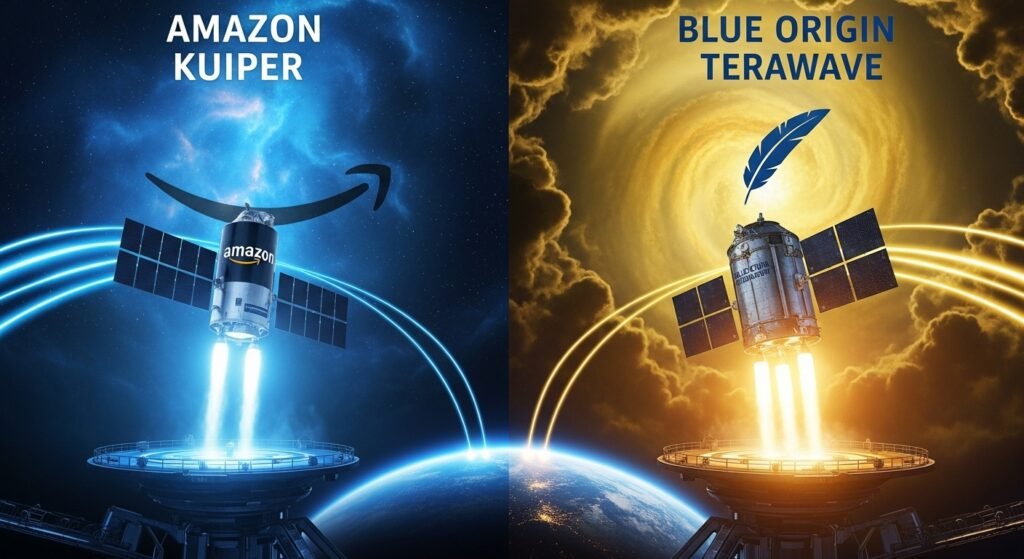
In a move that can only be described as “competitive sibling rivalry on a galactic scale,” Jeff Bezos’s rocket company, Blue Origin, has just announced its plans to launch TeraWave—an ultra-fast satellite network that seems designed to one-up everyone, including… Jeff Bezos.
That’s right. The man is now potentially competing with himself. It’s like watching someone challenge their own reflection to a chess match, but the board is the sky and the pieces cost several hundred million dollars each.
Meet the Contenders in the Bezos Bowl:
- In This Corner: Amazon Leo (formerly Project Kuiper). The “first-born” Bezos brainchild. It promises perfectly respectable, “I-can-stream-4K-while-my-robot-vacuum-maps-the-house” speeds of up to 1 gigabit per second. A solid, A- student of a satellite network.
- In The Other Corner: Blue Origin’s TeraWave. The new kid, the overachiever, the one who studied astrophysics for fun. It’s boasting symmetrical speeds up to 6 Terabits per second. That’s not just faster. That’s “download-the-entire-history of human cinema before your microwave popcorn finishes” faster. It’s 6,000 times zippier than its sibling. Someone is trying very hard for Dad’s attention (and by Dad, we mean Jeff Bezos).
The Blueprint: A Constellation of Overachievers
Blue Origin’s plan, filed with the FCC (probably on rocket-shaped letterhead), involves a staggering 5,408 satellites with laser links. They’re so eager they’re asking for regulatory waivers to “get this thing off the ground quickly.” Presumably, they’ll launch them on their New Glenn rockets, because what’s better than creating your own demand for rockets? It’s the space-age version of baking a cake because you’re hungry, but you have to invent the oven first.
The Billion-Dollar Question: Is Jeff Bezos Arguing With Himself?
This has left industry experts scratching their heads. Tech consultant Tim Farrar summed it up perfectly, wondering if this is:
- A subtle nudge to Amazon: “Psst. Keep funding space stuff. Or my other company will do it cooler.”
- A backup plan for Blue Origin: In case Amazon decides launching 3,200 satellites is enough and takes a spending pause.
- The ultimate corporate restructuring: Maybe Bezos wants to spin his satellite kids into one happy, vertically-integrated family under Blue Origin. After all, as Farrar notes, building your own rockets and your own satellite demand is a trick SpaceX has mastered. Why pay retail for launches when you can give yourself a “family discount”?
Technical Analysis: TeraWave Architecture and Strategic Implications
Blue Origin’s FCC filing for TeraWave specifies a multi-orbit constellation engineered to meet escalating demands for low-latency, high-availability bandwidth. The system directly targets performance gaps in existing satellite and terrestrial networks by prioritizing symmetrical, multi-terabit throughput and engineered redundancy.
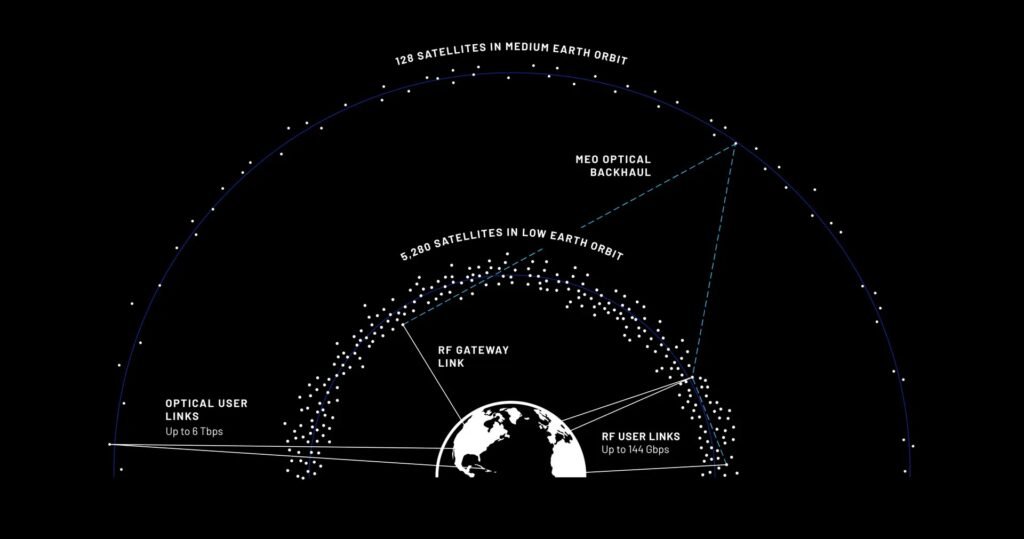
Constellation Architecture & Performance Specifications:
- LEO Layer (5,280 satellites): Provides the backbone for global coverage and low-latency connectivity, with specified user access speeds up to 144 Gbps.
- MEO Layer (128 satellites): Functions as a high-capacity backbone, offering terabit-level speeds for ultra-high-throughput trunking between major global hubs.
- Network Design Rationale: This hybrid LEO/MEO topology is designed to facilitate ultra-high-throughput links between core data hubs and distributed edge points-of-presence (PoPs). It explicitly targets geographic areas underserved by existing fiber infrastructure, providing a scalable alternative for last-mile and middle-mile connectivity.
Market Positioning & Competitive Landscape:
TeraWave strategically positions Blue Origin within the high-growth ecosystem of hyperscale data centers and enterprises requiring deterministic, high-speed WAN connections. This move places it in direct competition with SpaceX’s stated roadmap for terabit-capable Starlink V3 satellites, targeting the same government and enterprise sector.
The Bottom Line
So, while SpaceX’s Starlink is currently busy connecting RVs and remote cabins, the Bezos-iverse is having a private, high-stakes race in the executive suite. On one side, Amazon Leo is trying to bring internet to your door. On the other, Blue Origin’s TeraWave is preparing to blast data at governments and data centers with the force of a thousand suns.
It’s the ultimate corporate drama: not a hostile takeover, but a friendly(?) fire competition between a CEO’s past and a founder’s future. One thing’s for sure: when you have your own rocket factory, your homework is always going to be the most impressive in class. Even if you have to grade it yourself.