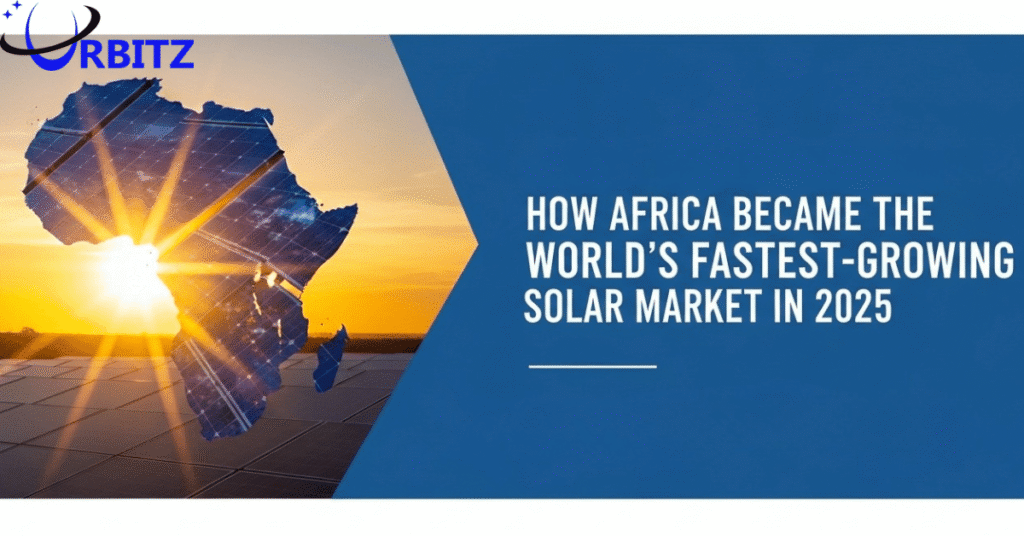
In 2025, Africa emerged not just as a player in the solar revolution — it became the fastest-growing solar energy market in the world. At a time when global solar capacity growth slowed compared with previous years, the African continent recorded remarkable gains in both installed capacity and market momentum, reshaping the renewable energy landscape and highlighting its role in the global energy transition.
Record Growth in 2025
According to recent industry reports, Africa accelerated its solar rollout with installations rising sharply in 2025:
- The continent added approximately 4.5 GW of new solar PV capacity, a 54% year-on-year increase — the fastest annual growth recorded.
- This surge was driven by both utility-scale solar farms and a rapidly expanding distributed solar market — including rooftop systems, mini-grids, and off-grid installations.
- Cumulatively, solar capacity across Africa could continue scaling fast toward over 31.5 GW by 2029, with many countries strengthening their solar pipelines.
This momentum defies the global slowdown in solar growth and positions Africa at the forefront of new renewable expansion based on the 2025 figures .
Countries Leading the Charge
While solar adoption is spreading continent-wide, several African countries stood out as leaders in 2025:
- South Africa — Led all nations with around 1.6 GW of new capacity, accounting for roughly one-third of Africa’s total installations.
- Nigeria — Added 803 MW, making it one of the fastest-growing solar markets as the country expands off-grid and commercial solutions.
- Egypt — Contributed about 500 MW, expanding utility-scale solar and rooftop deployments.
- Algeria — Installed 400 MW and continues to tap its significant solar resource potential.
Emerging markets like Morocco, Zambia, Tunisia, Botswana, Ghana, and Chad also each added more than 80–200 MW, demonstrating that solar growth is spreading beyond early adopters.
Why Solar Is Taking Off in Africa
Growing Demand for Reliable Power
Across Africa, energy demand continues to rise — driven by economic growth, urbanisation, and the need to power businesses and households. Solar energy, with its declining costs and modularity, provides a scalable way to meet this demand where traditional grids have struggled.
Affordable Technology and Imports
The availability of lower-cost solar panels and battery storage, especially manufactured in China, has helped make solar more accessible. Falling battery costs and cheaper panels have encouraged both large projects and small-scale systems.
Distributed and Off-Grid Adoption
In many regions with weak grid infrastructure, off-grid solar solutions — from home systems to community mini-grids — are becoming crucial for energy access. These deployments are hard to quantify but show strong underlying demand.
Supportive Policies and Reforms
Countries like Nigeria have introduced policy reforms — including phasing out diesel subsidies and enabling producers to feed excess solar power into grids — boosting renewable competitiveness.
Persistent Challenges
Despite the progress, Africa’s solar revolution faces obstacles:
- Financing gaps: Investment in the energy sector remains below what’s needed to fully exploit solar potential.
- Infrastructure limitations: Weak grids and limited storage capacity can constrain how much distributed solar can be integrated.
- Policy inconsistency: Variable regulatory environments across countries create uncertainty for investors.
Additionally, while import volumes are high, a significant share of that equipment is still not fully commissioned or operational, indicating work remains to translate capacity into available power.
What This Means for Africa’s Future
Africa’s solar growth in 2025 is more than a statistic — it’s a sign of a transformative energy shift:
- It expands access to electricity in underserved regions where grid connections are limited.
- It supports job creation, especially in installation, maintenance, and local services.
- It strengthens energy resilience by reducing reliance on fossil fuels and imported energy.
As Africa continues to harness its vast solar resources, the continent could become a global beacon for how renewable energy drives economic growth, sustainability, and energy independence.