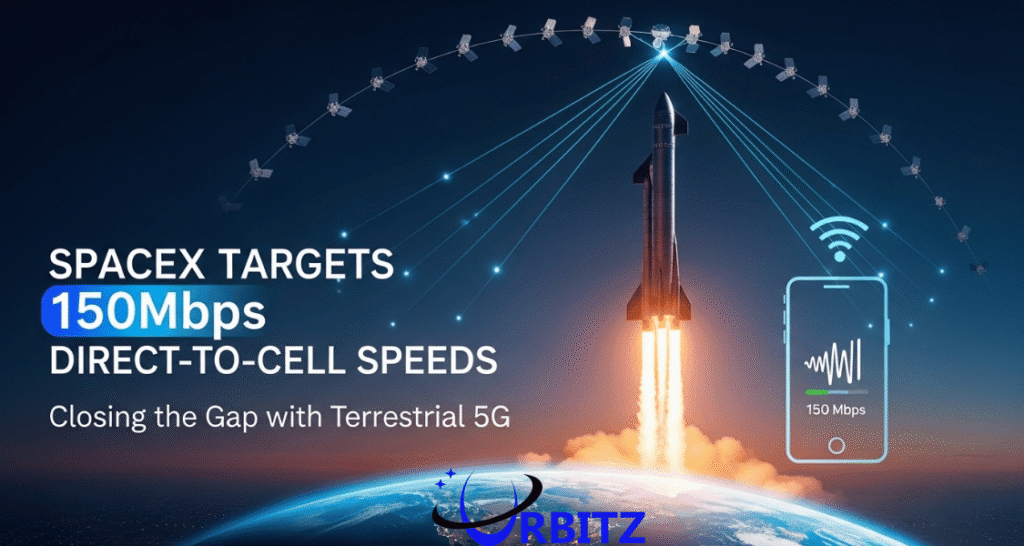
In a development that could redefine mobile connectivity, SpaceX has announced ambitious new performance targets for its next-generation Direct-to-Cell Starlink service. During the International Telecommunication Union’s Space Connect conference, SpaceX’s Spectrum & Regulatory Affairs Lead, Udrivolf Pica, revealed that the company is aiming for peak download speeds of 150Mbps per user .
This target represents a massive leap from the current capabilities of the service. If successful, it would transform Starlink’s cellular offering from an emergency texting tool into a true broadband competitor, bringing satellite-to-phone speeds closer than ever to the performance of terrestrial 5G networks .
From 4Mbps to 150Mbps: A 37x Leap Forward
To understand the scale of this ambition, it helps to look at where the service stands today. Currently, the Direct-to-Cell service—offered in the U.S. through a partnership with T-Mobile under the “T-Satellite” brand—is designed for basic connectivity. It allows users in cellular dead zones to send texts, use low-resolution video calls, and access select apps, but speeds are limited to roughly 4Mbps per user .
The new 150Mbps target is a staggering 37x increase over that baseline . For context, this places the upgraded satellite service in the same ballpark as existing ground-based networks. According to Ookla speed test data, the median download speed for AT&T’s 5G network in the U.S. is currently around 172Mbps, while T-Mobile’s 5G leads at approximately 309Mbps . While 150Mbps may not top those charts, it would make satellite connectivity a viable option for high-bandwidth tasks like HD video streaming, complex cloud applications, and even AI-driven services directly from a standard smartphone .
“We are aiming at peak speeds of 150Mbps per user,” Pica stated at the conference. “So something incredible if you think about the link budgets from space to the mobile phone” .
The Secret Sauce: More Spectrum and 15,000 New Satellites
Achieving this level of performance from space requires more than just wishful thinking; it requires a massive upgrade to the infrastructure. SpaceX has a multi-pronged strategy to make this happen.
The first piece of the puzzle is spectrum. SpaceX recently acquired radio spectrum from EchoStar (the parent company of Boost Mobile). This includes a valuable swath of the 2 GHz band (1980-2010/2170-2200 MHz), providing 50MHz of exclusive spectrum in the U.S., as well as capacity over other countries in the Americas . “More spectrum means a bigger pipeline,” Pica explained. “This means that we can expand what we can do with partners… we can do cellular broadband use cases, like AI or daily connectivity needs” .
The second piece is a dramatic expansion of the satellite constellation itself. The current Direct-to-Cell system relies on roughly 650 satellites. SpaceX has requested regulatory approval to deploy as many as 15,000 additional Direct-to-Cell satellites .
Reports indicate that these will likely be the advanced V3 satellites, which are expected to be launched via the Starship rocket. These next-generation satellites are reportedly the size of a Boeing 737 when their solar panels are deployed and offer 20 times the throughput capacity of the current V2 models . This combination of more spectrum and vastly more capable hardware will create the “bigger pipeline” necessary to deliver 5G-like speeds to phones on the ground.
Late 2027 Launch and a Competitive Landscape
This upgraded service won’t arrive immediately. SpaceX is targeting a rollout for late 2027. This timeline is strategically set to coincide with the finalization of the EchoStar spectrum deal and the expected readiness of the device ecosystem . Pica suggested that the timing is ideal for support of the 3GPP band n256, hinting at ongoing collaboration with chipset manufacturers like Qualcomm, MediaTek, and Samsung to integrate Starlink connectivity directly into standard mobile modems .
SpaceX is entering a rapidly heating market. The company’s 150Mbps target puts it ahead of rival AST SpaceMobile, which is currently touting peak speeds of 120Mbps per coverage cell using its BlueBird satellites . AST plans to have 45 to 60 satellites in orbit by the end of the year and counts AT&T and Verizon as partners . Meanwhile, Globalstar, which provides emergency satellite services for Apple iPhones, is also bolstering its constellation with the upcoming C-3 system .
The Future is “Starlink Mobile”
While SpaceX currently partners with carriers like T-Mobile, Rogers in Canada, and KDDI in Japan, the company’s long-term vision seems to point toward independence . The company filed a trademark for “Starlink Mobile” in late 2025, describing services that include “cellular personal communication services” . Elon Musk himself hinted at this future last year, stating that users should eventually be able to have Starlink as they would any other carrier .
The 150Mbps target is more than just a number; it is a declaration of intent. It signals SpaceX’s goal to eliminate dead zones permanently, bringing high-speed internet to remote national parks, rural highways, and even the arctic tundra . By 2027, the idea of losing a cell signal might finally become a thing of the past.