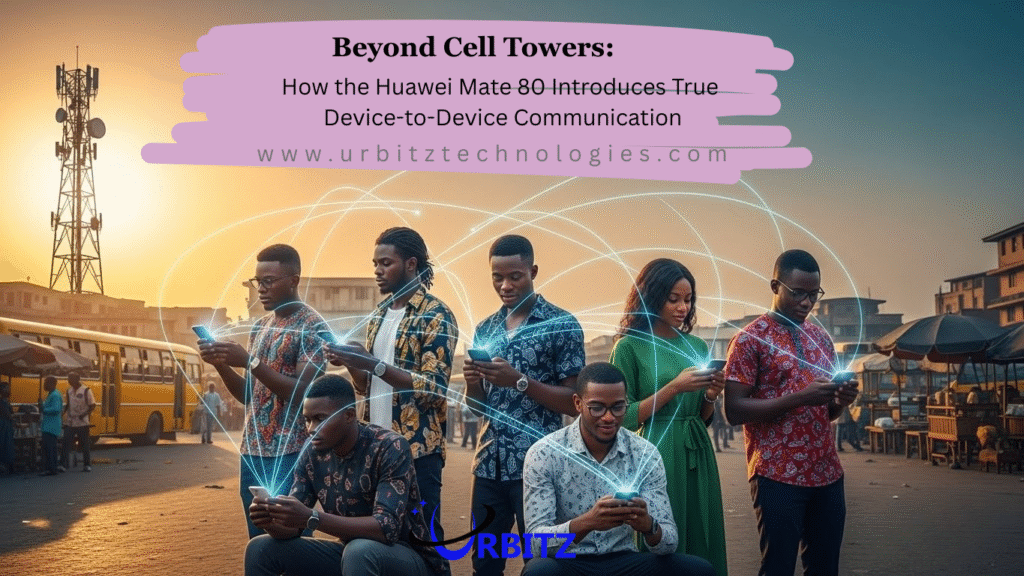
For decades, mobile phones have relied on giant infrastructure—cell towers, network core systems, and internet routing—to connect a call or send a message. Even when two people stood side by side, the data would travel hundreds of miles through operator networks before reaching another handset.
But that traditional model is beginning to change.
What Is Device-to-Device (D2D) Communication?
At its core, D2D means two devices talking directly without sending traffic through a network operator’s base station or central infrastructure. Instead of relying on the wider network to “carry the message,” the phones themselves establish the connection and exchange data locally.
In communications research and industry standards (especially with 5G and beyond), D2D is recognized for benefits such as:
- Lower latency — data travels straight between devices.
- Improved efficiency — less strain on cellular networks.
- Resilience in emergencies — works even when network infrastructure fails.
- New local experiences — social and location-based services thrive without needing coverage.
In research definitions: traditional cellular links route data through distant base stations, whereas D2D links bypass that step entirely and connect terminals directly.
The New Frontier: Phones That Communicate Without a Network
In recent months, smartphone innovation has started to bring these concepts to everyday users.
Huawei’s Mate 80 series (including the base Mate 80) is on the leading edge of turning network-independent communication into a practical reality.
What Huawei Is Doing
Huawei has introduced a version of offline communication that doesn’t require traditional cellular coverage, Wi-Fi, or even internet connectivity.
Here’s how it works:
- Using low-frequency and direct radio links, compatible Huawei devices can exchange calls and messages directly at distances up to about 7 km.
- This function is built into Huawei’s MeeTime communication app, enabling voice and messaging even when there’s no network available.
- On the Huawei Mate 80 series, tests show this feature even works in airplane mode, where typical wireless connections are shut off.
What makes this exciting is that the phone isn’t merely falling back on short-range Bluetooth or Wi-Fi Direct—it’s using a more robust radio communication method that increases range and reliability compared with conventional device pairing.
Why This Matters
Independence From Networks
Imagine:
- Sending a voice message without coverage.
- Making that call in a remote area where operators don’t deliver service.
- Communicating in emergencies when infrastructure is down.
Direct D2D communication makes these possibilities accessible on consumer hardware, without specialized radios or external hardware.
New Use Cases
Beyond emergency messaging, this trend could enable:
- Localized social networking without internet.
- Event-based private comms (festivals, rallies, crowd situations).
- Enhanced IoT interactions where devices coordinate directly. Wikipedia
The Bigger Picture: D2D Is More Than a Feature
The Huawei Mate 80 series is one of the first mainstream phones where direct, network-free communication is a practical built-in capability. That doesn’t just make it a flagship device—it makes it a milestone in mobile communications evolution.
What’s happening here isn’t just a new feature—it’s the beginning of a shift where:
- Mobile devices become nodes in their own networks.
- Connectivity isn’t limited by operators.
- People can stay connected even when infrastructure doesn’t.
That’s the true dawn of phone-to-phone D2D communication—and Huawei’s work with the Mate 80 family shows what’s coming next for all of us.
Wrap-Up
Direct phone-to-phone D2D communications are moving from research labs and standards discussions into real consumer hardware. The Huawei Mate 80 series makes a strong case that the future of connectivity will be:
More resilient — devices can connect without operators.
More capable — long-range communications untethered from networks.
More human — connections that work where people actually are.
If you’re exploring how mobile communication will evolve over the next decade, this is one of the first chapters.