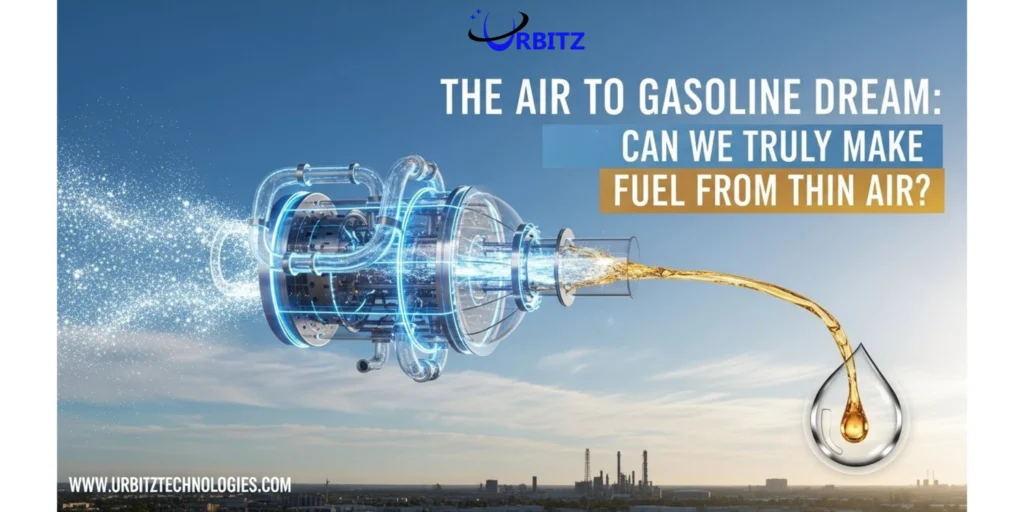
Imagine a future where your car is powered not by fossil fuels from deep underground, but by carbon dioxide captured directly from the atmosphere. It sounds like science fiction, but it’s the bold promise of a handful of pioneering companies, most notably Air Company in the US and, in the UK, Aircela. This technology—often called “air to gasoline” or “power-to-liquid”—is sparking both excitement and skepticism. Let’s dive into what it is, how it works, and whether it’s a true climate solution or a distracting mirage.
What Exactly is “Air to Gasoline”?
At its core, the process is a high-tech form of recycling. The goal is to take two main ingredients abundant in the air:
- Carbon Dioxide (CO₂): Captured directly from the atmosphere or from industrial emissions.
- Water (H₂O): Split into hydrogen and oxygen.
Through a series of chemical reactions—primarily a well-established process called the Fischer-Tropsch synthesis or newer catalytic methods—these elements are combined to create synthetic hydrocarbons: liquid fuels like gasoline, diesel, or jet fuel.
The resulting product is often termed a “drop-in” fuel. It’s chemically identical to its fossil counterpart, meaning it can be used in existing engines, pipelines, and infrastructure without any modifications.
Spotlight on Aircela
While the American Air Company has gained headlines for its vodka and perfume made from CO₂, UK-based Aircela is focusing squarely on the fuel market. Their mission is to produce sustainable aviation fuel (SAF) and other liquids to help decarbonize hard-to-electrify sectors like aviation and shipping.
Aircela’s proposed process mirrors the general concept:
- Direct Air Capture (DAC): Using specialized equipment to pull CO₂ from the ambient air.
- Green Hydrogen Production: Using renewable electricity (like solar or wind) to split water into hydrogen and oxygen via electrolysis.
- Synthesis: Combining the CO₂ and H₂ in a reactor with a catalyst to form synthesis gas, which is then processed into liquid fuel.
The grand vision is a closed loop: CO₂ emitted from burning the synthetic fuel is roughly equal to the CO₂ captured to make it, creating a carbon-neutral cycle—at least in theory.
The Soaring Potential: Why This Tech is Exciting
- Solves the “Long-Haul” Problem: Batteries are fantastic for cars, but they’re currently too heavy for long-distance aviation and shipping. Liquid fuels have an unmatched energy density. This technology could decarbonize these critical sectors without a complete transportation overhaul.
- Leverages Existing Infrastructure: There’s no need to replace billions of dollars worth of engines, gas stations, or airplanes. The switch could, in principle, be seamless.
- Energy Storage: It can act as a form of long-term, transportable storage for excess renewable energy (using surplus solar/wind power to make fuel).
- Air Quality Benefits: Synthetic fuels can be designed to burn cleaner, reducing particulate and sulfur pollution compared to conventional fossil fuels.
The Turbulent Headwinds: Major Challenges
For all its promise, the path to commercial, scalable “air gasoline” is fraught with obstacles.
- The Energy Mountain: The process is extremely energy-intensive. Capturing CO₂ (a dilute gas at 0.04% of the atmosphere) and splitting water molecules requires massive amounts of electricity. For this to be truly green, that energy must be 100% renewable and additional—not diverted from the grid.
- The Cost Ceiling: All that energy translates to high costs. Current estimates put synthetic gasoline at several times more expensive per gallon than fossil gasoline. Major cost reductions in DAC and electrolyzers are needed.
- The Efficiency Dilemma: Every energy conversion step (electricity → hydrogen → liquid fuel → engine) involves losses. Using renewable electricity directly in a battery-electric vehicle is far more efficient. Critics argue it’s wasteful to use precious green power to make inefficient synthetic fuels for cars when electrification is a better option.
- Scalability: To make a dent in global fuel demand, we would need an unimaginable number of DAC units and renewable energy farms dedicated solely to fuel production.
The Verdict: A Niche Player or a Game Changer?
So, is this a miracle or a myth?
The consensus among energy experts is that air-to-fuel will not—and should not—power our everyday cars. The efficiency math overwhelmingly favors direct electrification via batteries for light-duty transport.
However, its true potential lies in specific, hard-to-abate niches:
- Sustainable Aviation Fuel (SAF): This is the most compelling application. Aviation has few clean alternatives, and synthetic fuel is a top candidate for decarbonizing flights.
- Shipping and Heavy Freight: Where battery weight becomes prohibitive.
- Historical Vehicles: Providing a carbon-neutral fuel to keep classic cars and legacy machinery running in a net-zero future.
Conclusion: Cautious Optimism for a Clear Sky
Companies like Aircela are not selling snake oil; they are pushing the boundaries of chemical engineering and forcing us to think critically about a post-fossil fuel world. Air-to-gasoline is a fascinating and potentially crucial piece of the decarbonization puzzle, but it is not the whole puzzle.
It’s a technology for the last 10%, not the first 90% of our energy transition. Its success hinges on a massive, global build-out of cheap renewable energy first. As that green electricity base grows and costs fall, synthetic fuels could become the clean, powerful bridge that allows us to fly, ship, and transport goods without costing the Earth.
The dream of fuel from thin air is getting clearer, but it will take more than hot air to make it a reality. It will take relentless innovation, smart policy, and a clear-eyed focus on where it can truly make a difference.
What do you think? Is synthetic fuel a vital tool or a costly distraction? Share your thoughts in the comments.