On Wednesday, August 26, 2026, the Federal Government unveiled yet another new agency-style entity: the Renewable Asset Management Company, or RAMCO. Launched with great fanfare by Minister of Power Joseph Tegbe and REA Managing Director Abba Aliyu, RAMCO is billed as the solution to Nigeria’s renewable energy asset management woes—a professional body that will maintain publicly funded solar projects, collect revenue, and attract N3 trillion in private investment.
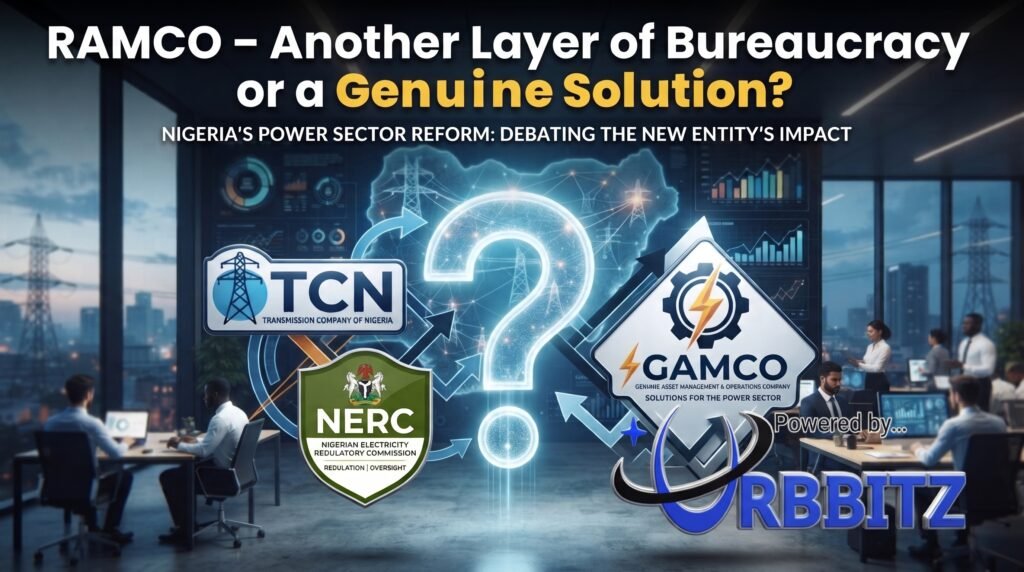
The problem? Nigeria already has a sprawling ecosystem of agencies, parastatals, and companies doing exactly this—or something suspiciously similar. From the Rural Electrification Agency (REA) that birthed RAMCO, to the newly created Grid Asset Management Company (GAMCO), to the Transmission Company of Nigeria (TCN), the Nigerian Electricity Regulatory Commission (NERC), and the Nigerian Independent System Operator (NISO)—the question must be asked: do we really need another one?
What Exactly Is RAMCO?
According to officials, RAMCO was established to address a genuine problem. An assessment of seven solar hybrid projects delivered under REA’s Energising Education Programme found that only three were in good or usable condition. The deterioration wasn’t due to engineering failure, Aliyu admitted, but because “we had not adequately institutionalised what happens after the commissioning of the project”.
RAMCO’s mandate is to professionally manage publicly financed renewable energy assets, contract competent operators, handle metering, billing and revenue collection, and establish reserves for equipment replacement. It is incorporated as a company under the Companies and Allied Matters Act, with government interests held through the Ministry of Finance Incorporated (MOFI).
On paper, this sounds sensible. But scratch the surface, and the duplication becomes glaring.
The REA Connection: Why Wasn’t This Already Their Job?
RAMCO was launched by the Rural Electrification Agency. The same REA that has been implementing renewable energy projects since 2017 under the Energising Education Programme. Deployed 82MW of solar hybrid generation across 22 federal universities and three teaching hospitals. REA that has another 150MW under construction or in the pipeline.
If REA is responsible for electrification—and its own website states its mandate is “expanding access to electricity in unserved and underserved communities across Nigeria through sustainable and renewable energy solutions”—why does it need a separate company to manage the assets it builds? Is asset management not an intrinsic part of project delivery? If REA can build, surely REA can also maintain?
The defence from officials is that RAMCO is “not another government agency” and “not another request for treasury funding”. But this distinction feels semantic. Whether called an agency or a company, it is still a publicly funded entity performing functions that arguably should have been within REA’s core competency from day one.
GAMCO: The Twin That Came First
If RAMCO feels familiar, that’s because it has a sibling. Just months earlier, in March 2026, President Tinubu constituted an 11-member committee to facilitate the incorporation of the Grid Asset Management Company (GAMCO) Limited.
GAMCO’s mandate? To revive idle generation assets, strengthen transmission infrastructure, and attract private capital into the electricity sector. It targets stranded power plants, aims to unlock 1,600MW of additional electricity, and is structured as a commercially run entity with shares held by the Ministry of Finance Incorporated.
Sound familiar? It should. The blueprint is identical: identify underperforming public energy assets, package them professionally, and attract private investment through commercial discipline. GAMCO for the grid; RAMCO for renewables. Two companies, same model, different silos.
The irony is not lost on industry watchers. When GAMCO was announced, stakeholders immediately raised concerns about duplication with existing institutions like TCN, NERC, and NISO. The Association of Power Generation Companies’ CEO explicitly queried “the duplication of roles with NISO”. Yet here we are, months later, watching the same pattern repeat with RAMCO.
The Oronsaye Report: A Blueprint Ignored
Perhaps the most damning context is the Oronsaye Report. Submitted over a decade ago, it identified the proliferation of federal agencies as a major source of bureaucratic duplication and cost, recommending the reduction of 263 statutory agencies to 161.
Today, Nigeria has over 900 Ministries, Departments, and Agencies (MDAs), costing the economy over N862 billion annually. Experts have repeatedly called for implementation of the Oronsaye Report as “the most practical roadmap for reducing the cost of governance and eliminating overlapping government agencies”.
Instead of rationalisation, we are witnessing proliferation. Instead of mergers, we are seeing multiplication. RAMCO is not a response to the Oronsaye Report—it is a repudiation of it.
The Real Cost: More Than Just Money
The concern here isn’t just about budgetary waste, though that is significant. Every new agency or company requires:
- A board and management team
- Staff salaries and benefits
- Office space and logistics
- Legal and administrative overhead
- Coordination mechanisms with existing bodies
But there is a deeper cost: institutional confusion. When multiple entities have overlapping mandates, accountability fragments. Who is responsible when a solar project fails? REA? RAMCO? The beneficiary institution? The contractor? The Ministry of Power?
Officials insist RAMCO will bring “professional management, stronger governance, maintenance discipline and measurable performance standards”. But these are not things that require a new institution—they are things that require political will and competent execution within existing institutions.
A Different Path Forward
No one disputes that Nigeria has an asset maintenance crisis. The statistic that only three out of seven solar projects remained operational is genuinely alarming. But the solution to institutional failure is not necessarily more institutions.
Consider what could have been done instead:
- Strengthen REA’s asset management capacity rather than creating a separate entity
- Merge RAMCO into GAMCO under a unified “Energy Asset Management Company” covering both grid and renewable assets
- Contract private sector asset managers through competitive bidding rather than creating a new public company
- Implement the Oronsaye Report by rationalising existing agencies first before adding new ones
The government’s approach seems to be: when an institution fails, create another one. This is not reform; it is avoidance.
Conclusion
RAMCO may well have noble intentions. The problem it seeks to address—the deterioration of public renewable energy assets—is real and urgent. But the solution feels like yet another layer of bureaucracy in a system already drowning in agencies.
Recall that when GAMCO was announced, experts warned that “new agencies won’t solve Nigeria’s power crisis”. The same applies to RAMCO. What Nigeria needs is not more institutions, but better performance from the ones we already have.
Until the government demonstrates a commitment to rationalising the existing ecosystem—rather than endlessly expanding it—Nigerians would be forgiven for viewing RAMCO not as a solution, but as yet another expensive distraction.
What do you think? Is RAMCO a genuine solution or just more bureaucratic bloat? Share your thoughts in the comments.