With the rapid advancement of power electronics, high-frequency (HF) inverters have completely overtaken traditional low-frequency (LF) types. Today, the vast majority of solar inverters on the market are high-frequency types, prized for their compact size, light weight, and superior efficiency (often reaching over 98%).
However, this technological shift has introduced a critical blind spot for many installers and end-users: Earthing (Grounding).
While the principles of grounding are not new, high-frequency inverters are far more “sensitive” to poor grounding than their old-school low-frequency predecessors. To ensure a safe and reliable installation, you must understand two distinct concepts: Functional Earthing and Protective Earthing.
Let’s break down what they are, why they are different, and why they are absolutely non-negotiable for modern solar systems.
1. What is Functional Earthing?
Functional Earthing (also known as Working or Operational Grounding) refers to connecting a specific point of the electrical circuit—usually the neutral point or a reference point—to the Earth.
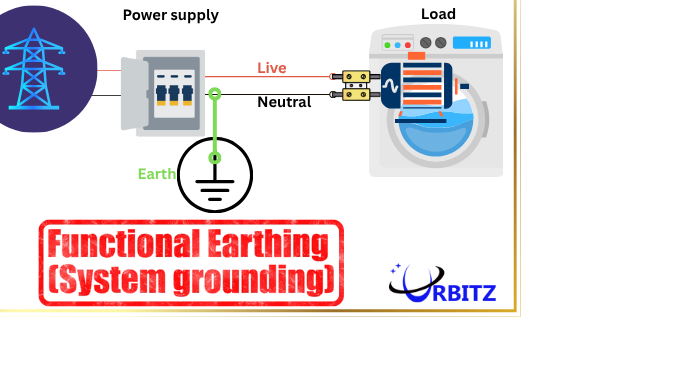
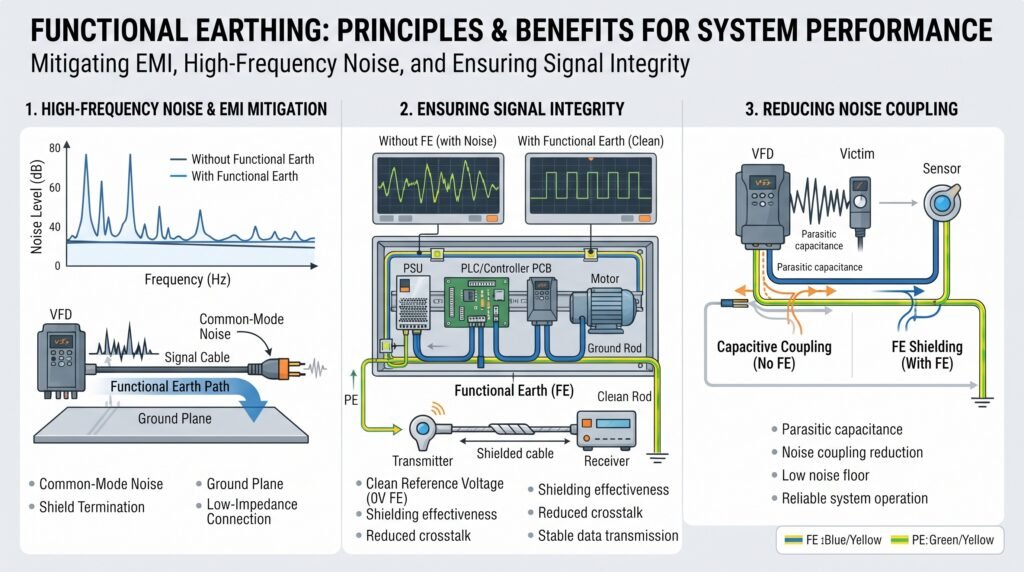
Simply put, Functional Earthing is for the machine. It is designed to make the equipment “work better.” Its primary roles include:
- Stabilizing Voltage Reference: It uses the Earth as a zero-potential reference, ensuring the inverter’s AC voltage and DC voltage detection circuits read accurately and operate stably.
- Suppressing Electromagnetic Interference (EMI): HF inverters switch IGBTs or MOSFETs at frequencies between 5 kHz and 30 kHz. This generates significant electric fields and electromagnetic radiation. Functional earthing provides a low-impedance path to sink these high-frequency harmonics into the ground, preventing the inverter from interfering with other sensitive electronics (and vice versa).
- Enabling Leakage Current Monitoring: Modern inverters constantly monitor DC leakage current to the ground for safety features like arc-fault detection. This requires a solid functional earth connection as a reference.
Important Note: According to IEC 60364-7-712, live conductors on the DC side of PV systems cannot be directly earthed. However, under specific AC/DC isolation conditions, the DC side may be grounded using a functional earthing method via a specific impedance.
2. What is Protective Earthing?
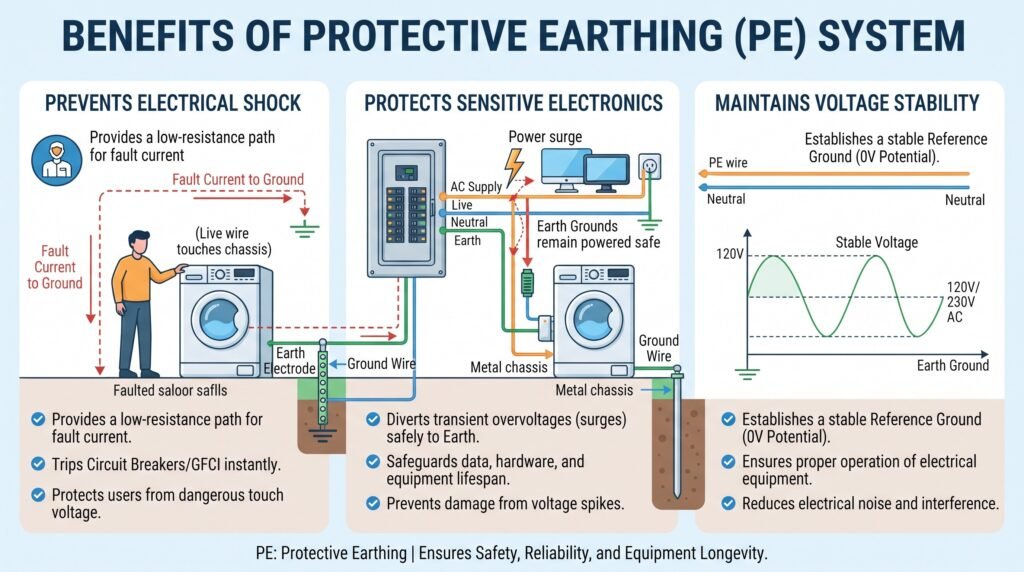
Protective Earthing (also known as Safety Grounding) involves connecting the metallic, conductive enclosures of the inverter (the chassis) to the Earth. The goal is to prevent electric shock when internal insulation fails and the chassis becomes live.
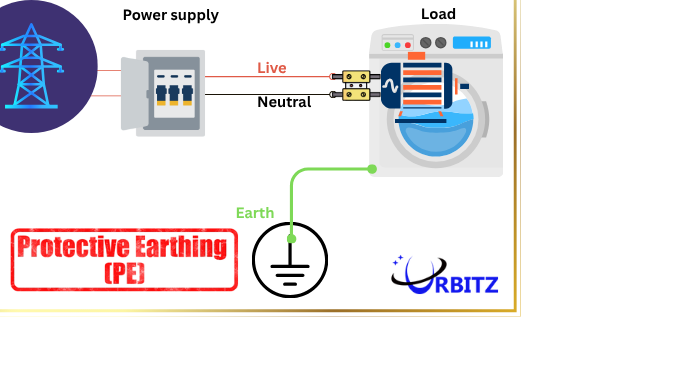
Simply put, Protective Earthing is for the human. Its core functions include:
- Preventing Electric Shock: If internal insulation breaks down and the metal chassis becomes energized, the protective earth provides an extremely low-impedance path for the fault current to flow directly into the ground. This keeps the chassis voltage close to zero, preventing a fatal shock to anyone touching it.
- Ensuring Safety During Faults: A proper protective earth guarantees that, under ground-fault conditions, the touch voltage between a person’s limbs remains safely low (generally < 50V).
- Preventing Charge Accumulation: Even during normal operation, HF inverters generate small leakage currents and high-frequency EMI currents that flow across parasitic capacitances. Protective earthing ensures these stray currents do not build up voltage on exposed metal parts.
According to international standards, the ground resistance for protective earthing of an inverter must be ≤ 4Ω.
3. Why are High-Frequency Inverters More “Demanding” on Grounding?
Low-frequency inverters (with heavy iron-core transformers) were incredibly forgiving. The transformer provided galvanic isolation, dampening noise and handling leakage currents naturally. High-frequency inverters, however, have four major Achilles’ heels regarding grounding:
a. High-Frequency Switching Creates Aggressive EMI
HF inverters switch at high speeds. This creates massive common-mode noise and high-order harmonics. Without a robust functional earth, this noise wreaks havoc on the inverter’s internal sensors, causing inaccurate MPPT tracking, frequent nuisance tripping, or complete communication failures.
b. Elevated Leakage Current Issues
The high-frequency switching pulses create significadnt parasitic capacitance between the PV panel and the ground. This generates a much larger high-frequency leakage current than low-frequency units. If the protective earthing path is high-resistance, these currents cannot dissipate, causing the chassis to “float” at dangerous voltages.
c. Transformerless Topologies Eliminate Isolation
To achieve peak efficiency, the majority of modern HF inverters are transformerless. This means there is no galvanic isolation between the DC input and the AC grid. In this setup, the protective earth provides the only barrier against translating DC-side faults into AC-side shock hazards.
d. Ground Fault Detection Sensitivity
Modern HF inverters incorporate sophisticated Residual Current Monitoring Units (RCMUs). These rely entirely on the quality of the functional earth reference. A poor functional earth can cause the RCMU to malfunction, potentially blinding the inverter to a genuine ground fault.
4. Practical Installation Tips for Safe Earthing
To get the most out of your high-frequency solar inverter and ensure absolute safety, follow these hard-and-fast rules:
Do Both Grounds, Always: Never assume one ground covers the other. The PE (Protective Earth) terminal on the AC side handles safety, while the dedicated functional earth terminal (or specific DC grounding point) handles operation. Do not mix them up at the connection point.
Ground Resistance Must be Measured: The combined ground resistance for both systems must be ≤ 4Ω. Never trust a visual inspection. Use a dedicated ground resistance tester (not a standard multimeter) to verify this after installation.
Ground Cables Must be Thick, Short, and Straight:
- Keep ground conductor length under 20 meters where possible.
- Avoid coiling or looping the wire—coils act as inductors that block high-frequency fault currents.
- Minimum cross-section should be ≥ 2.5mm² (though we strongly recommend ≥ 10mm² for HF inverters to handle high-frequency impedance).
Single Point Grounding (Star Grounding): If you have multiple inverters at a single site, connect all protective earth terminals to a single common grounding busbar. Avoid daisy-chaining grounds from one inverter to the next, as this creates ground loops that induce massive interference.
Separate Signal and Power Grounds: If using monitoring or communication lines, ensure their functional grounds are separated from high-power protective grounds to prevent noise coupling, connecting them only at the main earth bar.
Final Takeaway
The industry’s shift to high-frequency solar inverters is overwhelmingly positive—better efficiency, smaller footprints, and lower costs. However, this evolution demands a step-up in installation expertise.
Functional Earthing keeps the complex digital brains of the inverter thinking clearly; Protective Earthing keeps your body safe from harm. By respecting both and treating them as distinct, critical systems, you guarantee that your solar investment delivers not just maximum energy yield, but maximum peace of mind.
Stay grounded, stay safe.